We’ve got $100 billion to spend. What do you want to do?
If you, your family and friends in North Carolina had $100 billion dollars to spend every year, how would you spend it?
If you knew that by intentionally circulating those dollars amongst yourselves, you would all always remain wealthy.
If you knew that you, your family and friends had all the talent, expertise, and brilliance to build the kind of internal economy that ensured that no one you knew went hungry, that all the children in your circle could go to college, and that those who didn't would land into a family business, how would you feel?
How would you feel about your place, your status, your future in this ancestral land of yours, the American South?
Sit with those questions. Do not rush past them. Let them be as real as the chair you are sitting in.
Because here is what I need you to know before you read another word: that hundred billion dollars is not a fantasy. It is not a grant we are waiting on, not a settlement that may never clear, not a promise from anyone who has ever broken one. It is already here. It arrives every single year, on time, without anyone's permission.
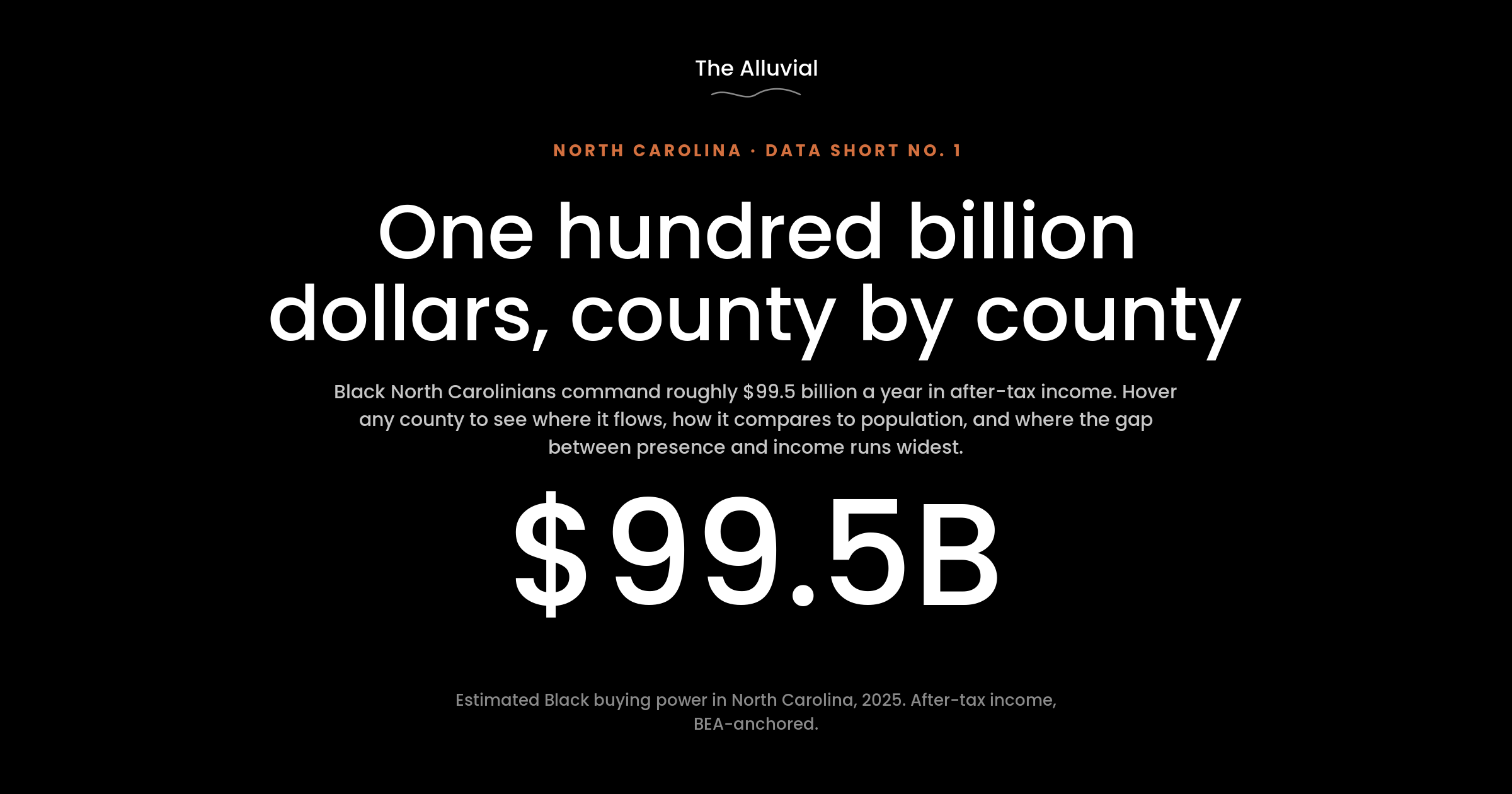
Click to above to visit the full data interactive.
In 2025, Black North Carolinians will command an estimated $99.5 billion in after-tax income. Roughly one hundred billion dollars, moving through our hands, our households, and our neighborhoods, from the towers of Charlotte to the quietest county in the Black Belt. You can watch it flow, county by county, on the map that runs alongside this piece. The money in the daydream and the money in our accounts are the same money. We have simply never been invited to see it all at once.
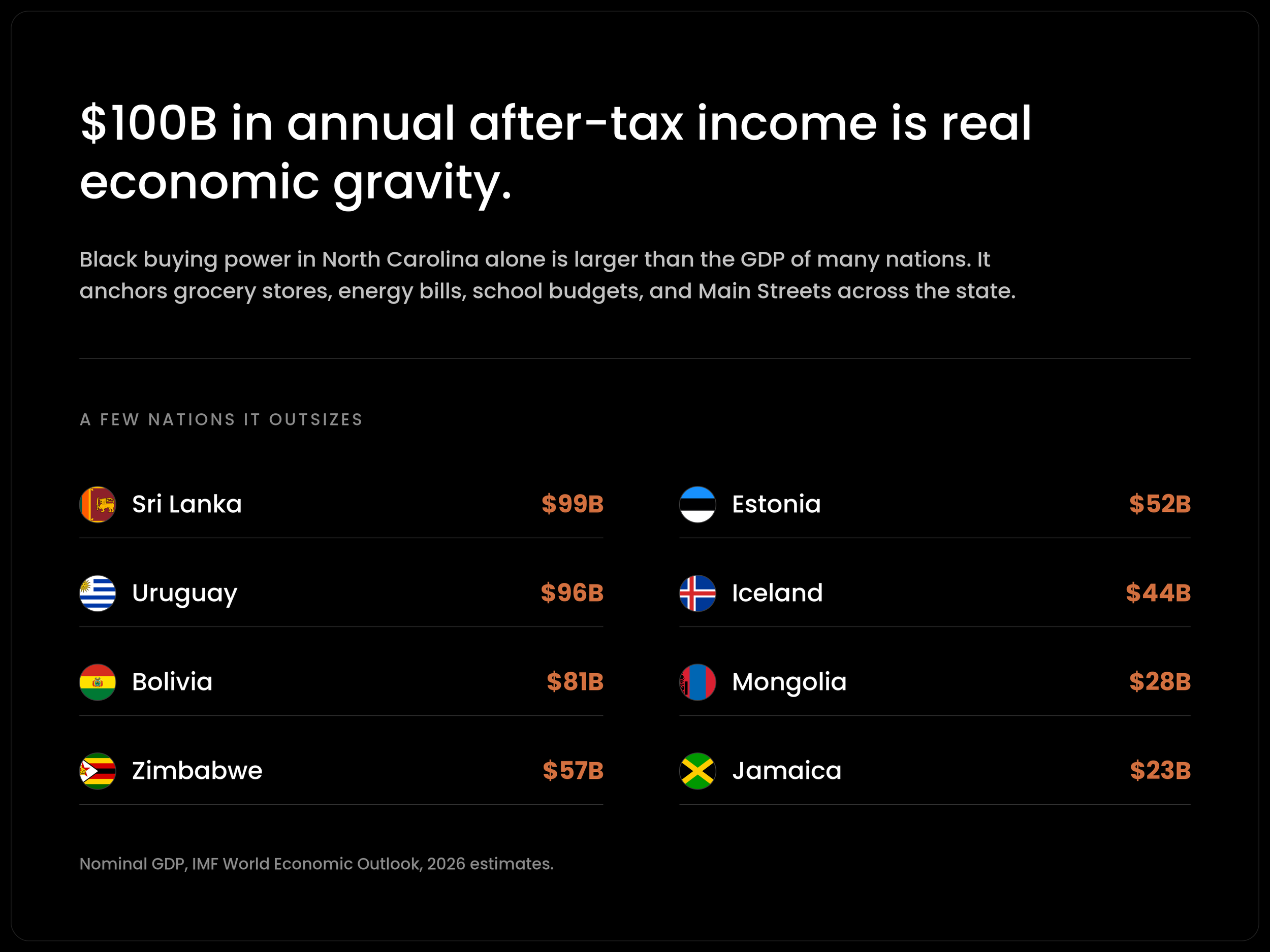
So let me put that number somewhere you can feel it in your chest. Ninety-nine and a half billion dollars is larger than the entire economy of Sri Lanka. Larger than Uruguay. Larger than Bolivia, than Estonia, than Iceland. If Black North Carolina were its own nation, it would out-earn whole countries that hold seats at the United Nations. Read that again. We are not a minority line item in somebody else's ledger. We are a nation-sized economy that has never once been told to behave like one.
So why does it not feel that way? Why do so many of us feel the opposite of powerful right now?
Here is the hard part, and I will not dress it up. Black residents are nearly a fifth of this state, about 19.8 percent of the population, and yet we earn only about 14.6 percent of its income. That gap has barely trembled in five years. The pool of money keeps rising and our slice holds almost perfectly still. If income simply matched our presence, our buying power would already be closer to $128 billion. The missing piece, roughly $28 billion every single year, is not a mistake. It is a structure built long before we got here, and it is most brutal in the rural counties where we are the majority.
And it gets quieter and more costly still when you follow a dollar after it lands. Nearly 40 cents of it goes straight back out the door for housing, most of that to a landlord's deed or a bank's mortgage. A little more to the gas station, the insurer, the national chains. Most of it is gone within days, and almost none of it stays long enough to become something we own. Economists like Jared Ball and Darrick Hamilton have spent their careers reminding us of the difference, and it is the most important sentence in this whole essay: buying power is flow, not wealth. The dollar visits us. It does not yet live with us.
The Alluvial · North Carolina
Where the $99.5 billion goes
How Black North Carolinians' after-tax income is spent, by category. Hover any flow for the dollars behind it.
Spending mix from the U.S. Bureau of Labor Statistics Consumer Expenditure Survey, 2024 (Black or African American households), applied to $99.5B in projected 2025 North Carolina Black buying power. Flows are sized by share of spending, an illustrative allocation using the national spending pattern, not a state-level measurement.
But a river can be moved. That is the entire point. That is the possibility hiding inside the cold arithmetic.
Because if the dollar is already in our hands, then the only question left is how long we hold it before we let it go, and to whom. Every dollar we keep circulating among ourselves, into a home owned free and clear, a stake in a cooperative, a deposit in a Black-owned credit union, a family business that hires the next generation, is a dollar that stops being flow and starts becoming wealth. The dream in those four questions at the top is not underfunded. It is fully, extravagantly funded. What it has lacked is not money. It has lacked a decision.
And we have made that decision before, in far darker seasons than this one. The history of Black America is a history of collective economics, of mutual aid societies and buying clubs, of credit unions and farm collectives and land held in common, built precisely when the wider world offered us the least. Our people turned freedom dues into schools and swampland into harvest. The instinct to pool what we have and protect one another with it is not a new strategy. It is an inheritance. It is in the soil of this ancestral land.
So to anyone reading this who feels the ground shifting beneath them, who feels watched, threatened, or told in a hundred small ways that your future here is not yours to hold, I want to leave you with the one truth this data cannot take away. This power is self-generated. It cannot be vetoed by any administration, struck down by any court, or reversed by any hostile hand reaching into our communities. No one voted it into being, so no one can vote it away. It shows up every year because we show up every year. That is the kind of power that outlasts an election, and it has always been the kind our ancestors trusted most.
So I will ask you one more time, the way I began. If you and everyone you love had a hundred billion dollars to spend every year, how would you spend it? How would you feel about your place, your future, your standing in this land your people made bloom?
You do have it. We do. The only thing left is to act like it, together, and to build the one thing in this world that cannot be undone.
Let's build it.
William Munn, PhD
Data: Black buying power in North Carolina is estimated at $99.5B for 2025 (after-tax income, anchored to U.S. Bureau of Economic Analysis state personal income and distributed with U.S. Census Bureau American Community Survey 5-Year Estimates, 2020–2024). Population and income shares from the same ACS data. National GDP comparisons from the International Monetary Fund World Economic Outlook, 2026 estimates. Spending breakdown from the U.S. Bureau of Labor Statistics Consumer Expenditure Survey, 2024 (Black or African American households), applied to the state total.